
Menu
Richard Housen, UK & Ireland Channel Manager at Impossible Cloud, breaks down the US CLOUD Act threat, zero-egress pricing, immutable backups, and how European object storage gives MSPs and their clients true data sovereignty with no bill shock.
Host: Ray Quatermain, Fortuna Data · Guest: Richard Housen, Impossible Cloud
Richard Housen - Impossible Cloud
UK & Ireland Channel Manager, responsible for launching Impossible Cloud into the UK market. Background spanning MSP businesses in South Wales, multinational telecoms (BT), and channel-led cloud sales. Impossible Cloud has been established in Central Europe and EMEA since 2020.
If your organisation stores data with a US-headquartered cloud provider, your data may not be as private as you think — regardless of which data centre region it sits in. This is the core argument Richard Housen opened with, and it's one that is reshaping how UK businesses think about cloud procurement.
The US CLOUD Act (Clarifying Lawful Overseas Use of Data Act) grants the US government the right to compel any American cloud company to hand over data it holds — anywhere in the world. The key distinction Richard makes is that data sovereignty is not about where data is stored; it's about who has jurisdiction over it. A UK-region bucket with a US-headquartered provider is still subject to US law, because the company itself is American.
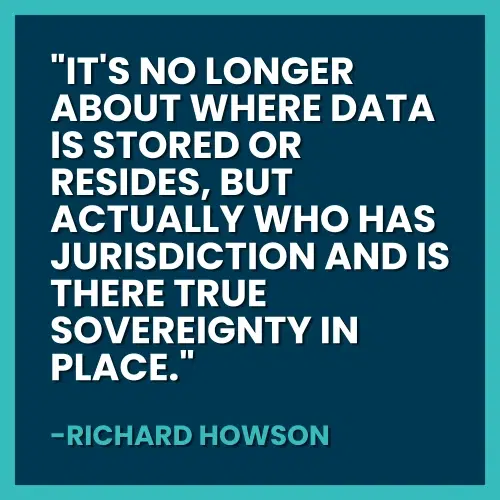
"It's no longer about where data is stored or resides, but actually around who has jurisdiction and whether there is true sovereignty in place." Richard Housen, Impossible Cloud
Impossible Cloud sidesteps this entirely by being a European company headquartered outside US jurisdiction. It can guarantee where data is stored, who has legal control and access to that data, and how that data is protected — the three pillars Richard cites for genuine sovereignty. For UK businesses, this means data stored with Impossible Cloud can be geofenced to the UK with no exposure to extraterritorial US law enforcement requests.
Hyperscalers have been remarkable at making cloud accessible and scalable for organisations of every size. But as Richard explains, that accessibility has come at the cost of pricing transparency and long-term cost control.
The problems compound in three ways. First, pricing complexity: the headline storage rate looks simple until you start incurring API call charges, egress fees when accessing or moving data, and retention-period penalties that punish you for retrieving your own files too quickly. Second, cost unpredictability at scale: as data volumes grow — Richard notes data is growing at approximately 25% year-on-year, meaning a storage set doubles in under three years — so do all these variable charges. Third, a lack of transparency and ownership: the CLOUD Act issue above means that even "your" data may not truly belong to you.
Richard described speaking to companies that had hired dedicated teams whose sole job was to understand and manage their cloud storage bills. "That blows my mind," he said — and it is a reality that points to a broken pricing model, not a complex product.
"We operate a simple price-per-terabyte model with zero API call charges, zero egress fees, and zero retention period on data. The price that is agreed is the price that will be paid." Richard Housen, Impossible Cloud
This matters enormously for MSPs and resellers. A channel partner quoting a client for backup and storage needs to know what that client will be charged in month one, month twelve, and month thirty-six. With hyperscaler variable pricing, that confidence is impossible. With Impossible Cloud's flat per-terabyte model, partners can quote confidently without the risk of embarrassing bill shock conversations down the line.
Cost and sovereignty arguments only matter if the underlying platform performs. Richard addressed this directly: Impossible Cloud provides a single tier of storage always hot, always fast with no cold, warm, or glacial tiers to navigate. "With us it's always hot," he said, contrasting with the layered complexity of choosing between storage classes that each carry different latency and retrieval costs.
Impossible Cloud runs daily cloud write tests and benchmarks its performance against competitors. The result: it consistently performs at or above hyperscaler speeds, with notably low variance meaning consistent throughput rather than peaks and troughs. For backup and recovery workloads in particular, this consistency is critical.
Veeam integration has been extensively tested as part of the platform's version two launch, with strong results across large backup sets making Impossible Cloud a well-suited S3 target for Veeam-heavy environments.


Ray walked through a scenario that many MSPs will recognise: a client has been hit by ransomware. How quickly can Impossible Cloud get them back?
Richard confirmed that recovery speeds from Impossible Cloud would not be the limiting factor the organisation's internet connection would be. The platform delivers data at speeds that exceed typical WAN connectivity, meaning the bottleneck is always the last mile rather than the cloud storage layer.
All data stored on Impossible Cloud is fully immutable and managed through the platform's management console. Partners can set hard immutability periods (for example, 30-day CCTV retention windows that automatically expire), configure versioning, and apply identity access management (IAM) policies and multi-factor authentication. Data is encrypted both in transit and at rest. The platform is designed to meet enterprise-grade S3 security requirements without adding complexity for the end user.
Impossible Cloud is 100% S3-compatible, which means it works as a storage target for any S3-capable platform without custom development. The platform has native, certified integrations with Acronis, Panzura, HYCU, Veeam, and Vaulte, with QNAP certification in progress at the time of recording.
For MSPs managing multiple clients across multiple backup tools, this is significant. Rather than maintaining separate storage repositories for each vendor, a partner can point all S3-compatible backup jobs Veeam here, Acronis there at a single Impossible Cloud account. Storage is consolidated, billing is simple, and management stays in one console.
Ray demonstrated this live during the podcast: using a QNAP NAS appliance already in the studio, he had set up an S3 connector to Impossible Cloud as a generic S3 target. The integration worked immediately, with no specialised configuration. "It just worked," he noted.
One of the less-discussed costs of hyperscaler cloud is what Richard calls the "silent lock-in." Once significant data volumes are established with a major cloud provider, the combination of high egress fees and migration complexity makes moving that data to another platform genuinely expensive and time-consuming. As data grows 25% year on year, the cost of switching doubles every few years alongside the data volume itself.
Because Impossible Cloud is S3-compatible, moving data away from it — or moving data in — carries no lock-in penalty. Partners can change pointers rather than copying petabytes of data, and there are no egress charges to punish the decision to switch. Richard's view is that data belongs to the customer: "They should always be able to move that data away without penalty, as a minimum."
What was once a niche compliance requirement for healthcare, finance, and public sector organisations has broadened significantly. Richard described a clear market shift: organisations across all sectors are now actively seeking UK sovereign storage solutions, and UK public sector tenders increasingly specify UK data sovereignty as a mandatory requirement rather than a preference.
The distinction they need to demonstrate is meaningful. Storing data in a UK region of a US-headquartered cloud provider gives data residency — the data physically sits in the UK. But it does not give sovereignty, because the data remains under the legal jurisdiction of a US company and therefore accessible under the CLOUD Act. Impossible Cloud can provide the full three-part proof procurement teams are increasingly asking for: location, legal control, and access governance.
"If given the opportunity to choose between a UK sovereign solution and an American company on par for performance and reliability, 99% of people would choose the European option. And that's what we're getting to now." Richard Housen, Impossible Cloud

Beyond backup and recovery, Richard highlighted three growing use cases where Impossible Cloud's combination of sovereignty, performance, and cost transparency is particularly well-suited:
CCTV and physical security video. Organisations can set immutable retention periods (e.g. 30 or 31 days) with automatic deletion at expiry, enabling compliant, cost-controlled video storage at scale without manual management overhead.
Media and entertainment. Film and video production generates large volumes of high-value intellectual property. UK-sovereign storage with geofencing ensures that creative IP cannot be accessed by non-UK jurisdictions — an important protection for studios and production companies working with commercially sensitive content.
AI training datasets. As AI adoption accelerates, the volumes of unstructured data required for model training are growing rapidly. S3 object storage is the natural home for this data, and the cost of storing large training datasets makes Impossible Cloud's per-terabyte pricing particularly attractive. Richard noted that not all AI data requires nanosecond latency — a vast proportion is training and inference data that can be served efficiently from object storage at a fraction of the cost of high-performance block storage.
Impossible Cloud operates exclusively through the channel — it does not sell direct to end users. Channel is described as central to the company's growth strategy, and Richard's role is specifically to build the UK partner network.
For resellers and MSPs, the partnership is designed to be genuinely two-way. Partners benefit from the ability to offer a differentiated, UK sovereign cloud storage proposition that hyperscalers cannot match, protected margins, and a platform that is straightforward to manage and explain to clients. Impossible Cloud benefits from partners' long-standing local relationships and market knowledge.
For technically advanced partners, the full management console is also accessible via API. Every action available in the GUI — creating new buckets, setting up clients, configuring access controls, drawing down billing data in CSV format — can be automated via API call. This makes it practical to integrate Impossible Cloud directly into PSA tools, ticketing systems, and client onboarding workflows, and even to white-label the storage offering under a partner's own brand.
Ray closed the conversation by asking where Richard sees cloud storage in five years. His answer was clear: the era of defaulting to a single hyperscaler for all cloud workloads is ending. The next phase will be a multi-cloud ecosystem of specialist providers, each doing one thing exceptionally well, assembled by partners and enterprises into a composite solution.
Within that model, Richard's ambition for Impossible Cloud is to become the default S3 object storage layer — the go-to destination for unstructured data storage within a multi-cloud environment, chosen on the basis of sovereignty, performance, and transparent pricing. Cost transparency itself will become a buying criterion as cloud budgets grow: organisations will need to forecast storage costs accurately, and that requires the simplicity of a flat per-terabyte rate.
The US CLOUD Act gives the US government legal authority to demand data from any American cloud company, regardless of where that data is physically stored. UK businesses using US-headquartered cloud providers — even in UK data centre regions — have no guaranteed protection from this access. Choosing a European cloud provider like Impossible Cloud removes this exposure entirely.
Data residency means your data is physically located in a specific country. Data sovereignty means you control who has legal jurisdiction and access to that data. You can have UK data residency with a US-headquartered provider and still lack UK data sovereignty, because the company remains subject to US law. True sovereignty requires a non-US provider that can legally guarantee both location and legal control.
No. Impossible Cloud uses a flat price-per-terabyte model. There are no API call charges, no egress fees, and no retention period penalties. The price you are quoted is the price you pay.
Yes. Impossible Cloud is 100% S3-compatible and works with any S3-capable platform. Certified integrations include Veeam, Acronis, HYCU, Panzura, and Vaulte. Veeam has been extensively tested against the platform with strong performance results across large backup sets.
Yes — Impossible Cloud is a channel-only business. Partners create and manage storage buckets for clients through the management console, set storage limits, and bill clients on actual usage. The full management console is also available via API for automation and white-label delivery.
All data stored on Impossible Cloud is fully immutable. In the event of a ransomware attack, recovery speeds are limited only by the organisation's internet connection — Impossible Cloud will never be the bottleneck. Partners can configure versioning and immutability periods directly from the management console.
Fortuna Data is a channel partner with Impossible Cloud. If you're an MSP or reseller looking to add a compliant, transparent, high-performance S3 storage layer to your stack or if you're an organisation evaluating alternatives to hyperscaler storage get in touch.